Karlsruhe Majolica Estate – Mythical Creatures, Birds, Early Models
In early October 2026, an enquiry reached me that I could not have dreamed up more beautifully: an estate in Karlsruhe, grown over decades, with a clear focus. Early Karlsruhe Majolica from the first half of the 20th century, along with paintings, prints, and drawings by Baden artists.
For me, a circle closed. Only this year I had led the closing auction of the Staatliche Majolika Manufaktur Karlsruhe, accompanying the end of the manufactory’s history. Now, suddenly, its beginning lay before me: the manufactory’s first creative period, the years from 1901 into the 1950s. The second half I knew from over 10,000 objects. The first I now got to discover piece by piece.
From the first photo to the scholarly literature
The process was the same as in every one of my projects. I first requested photographs to gauge scope and quality. Then I acquired the authoritative literature: the exhibition catalogue of the Badisches Landesmuseum with the manufactory’s model register, as well as the relevant monographs. About ten days later, I was on site.
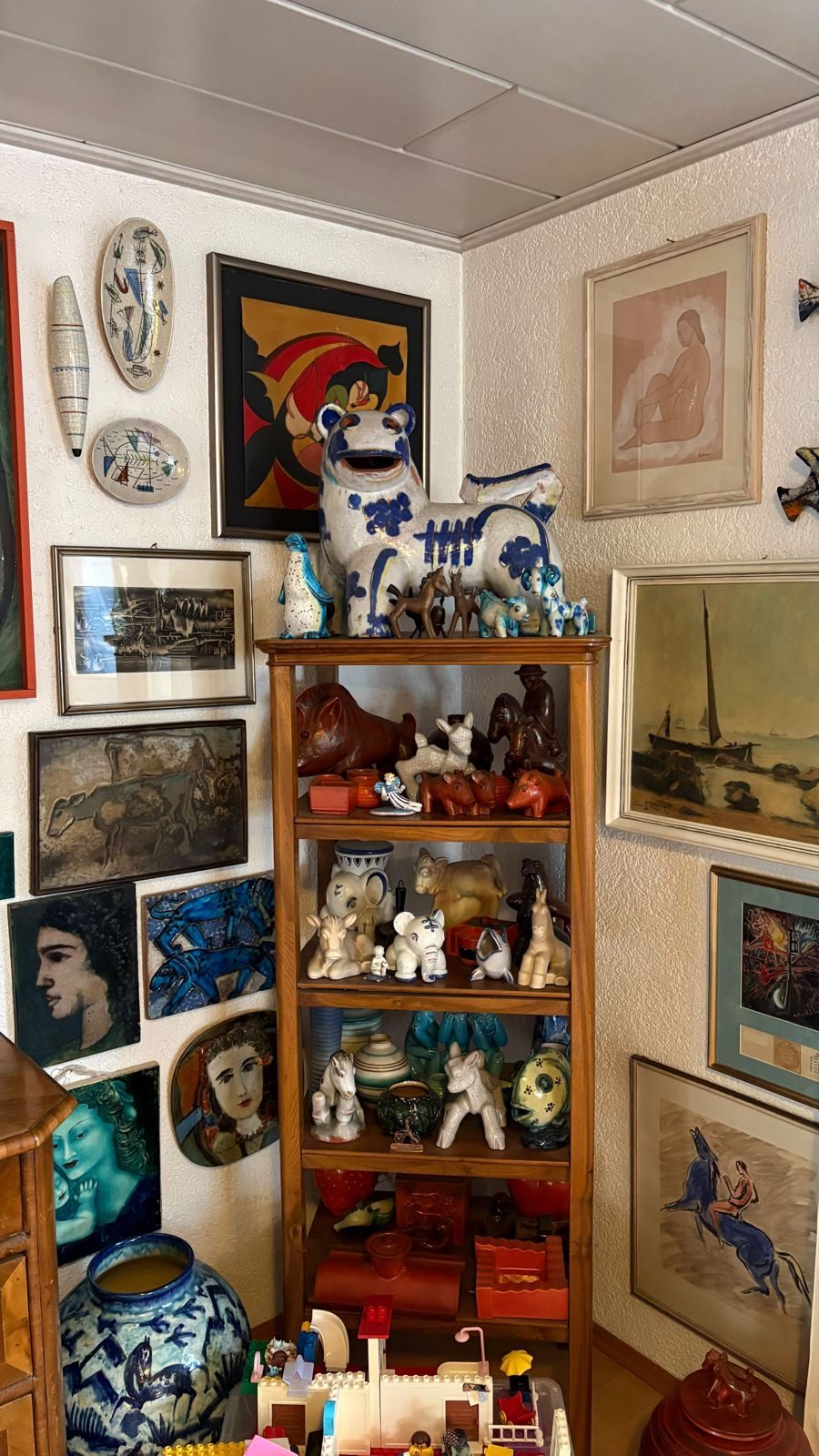
What I saw there was more than a ceramics collection. It was a house in which people had collected, read, and compared for decades. Majolica in every room, tiles, masks, and relief plaques on the walls, a densely hung gallery of Baden painting in the stairwell. And everywhere, scholarly literature on Karlsruhe and its artists.

275 lots, well over 400 objects, one plan
My task: record the entire holdings and prepare the auction. In the end there were 275 numbered lots with well over 400 objects, each with a finished catalogue text, researched art-historically, substantiated with literature references and model numbers.
The most important step is the careful selection. I went through every single piece and decided: what carries a lot of its own? What is not auctionable on its own but gains in the right ensemble? And what does not belong in the auction at all, but is better marketed through other channels? Exactly this sorting gets the best out of the collection in the end. Not every object needs the same path, but every object needs one.
From my network, I sought and found the right auction house for exactly this niche: Siebers Auktionen in Stuttgart, with Yves Siebers. I took over the communication for the family, brought the experts to one table, and negotiated the consignment terms. Because the groundwork had already been done, we were able to achieve noticeably better consignment conditions for the family. Preparation pays off quite directly here.
My personal discovery: Ludwig König
Every project has one artist who stays with you. This time it was Ludwig König (1891 to 1974), since this collection my personal favourite artist of the Karlsruhe Majolica. His mythical creatures from the 1920s have a playfulness and modernity you would hardly expect of that era: small turquoise-glazed beings, half dog, half fantasy.
The masterpiece of the collection is a large mythical creature by Ludwig König: white-glazed, craquelé, with cobalt-blue brush painting, around 42 by 46 centimetres. A unique piece from the 1920s that never went into serial production.

During the research came the most beautiful surprise: for several pieces of the collection, the counterparts stand today in the Nasjonalmuseet in Oslo. König’s small mythical creatures and early bowls have direct comparison pieces there in the museum’s collection. A Karlsruhe living room and a Norwegian national museum, the same models.
Pottner’s birds, Laeuger’s elephants, Thoma’s very first models
Alongside them, the large animal figures by Emil Pottner (1872 to 1942): his ornithological model series with cockatoos, macaws, and native birds, including a life-size blue-and-yellow macaw of 75 centimetres in height and workshop pieces inscribed in his own hand. Anyone who encounters early Karlsruhe Majolica by Pottner understands immediately why these bird figures are sought after today.
Of Professor Max Laeuger, the collection contains rare Edelmajolika elephants from 1927 and a whole series of his vases from the early 1920s with slip painting, some of them unique pieces. Plus very early models by Wilhelm Süs, the founder and artistic director of the manufactory, from the years around 1901 to 1904. And a wall plate after Hans Thoma with model number 18: one of the very first models the manufactory issued at all in 1901.

A collector who went further than the ceramics
What touched me most was how this collector worked. He did not merely gather ceramics. Through the ceramics he came to the artists, through the artists to the literature, and at some point he began to etch and paint himself. A holistic engagement with the Karlsruhe art scene, from the object to the book to his own hand.
The collection’s paintings held surprises too: original paintings by Wilhelm Süs, among them a Saint George in oil. Individual works by other artists I sent to the responsible experts in Paris for authentication. Exactly this diligence is what distinguishes a serious estate cataloguing from a quick clearance.

It was a gift to enter a subject from the outside, one I first had to read my way into. And to know in the end: each of these 275 lots now has a story, a name, and a place in the catalogue.
What happens next
The auction is expected to take place in April 2027 at Siebers Auktionen in Stuttgart. The family of the late collector was relieved above all about one thing: that everything lay in one hand. From the first survey through the selection and the catalogue texts to the handover to the auction house. Now we are both looking forward to the result, the family and I.
How such projects proceed in general is documented on the page Collections & Estates.
Since November 2026 I have held a permanent position in the auction industry and am currently not taking on new mandates.
If you are facing a collection or an estate, I am happy to recommend suitable contacts from my network.
Let’s connect