Auction at Heidelberg Castle
An auction is a format with clear rules: call the lot, solicit bids, award the hammer. Efficient, but rarely explanatory. In October 2022, we experimented with what happens when this format is opened up – combining it with an exhibition, a guided tour, and an open expert discussion into a single evening that takes place simultaneously in the hall and on six international streaming platforms.
The occasion was Peter Robert Keil’s 80th birthday. The Keil Collection Heidelberg presented a major anniversary exhibition under the title “IchFarbe – ein Maler sagt ich” (I-Color – a painter says I) – curated by Dr. Kristina Hoge and, thanks to the support of GIM, at an exceptional location: the Ottheinrich Building at Heidelberg Castle. Over 600 m², four rooms, ceiling heights exceeding six meters. Keil’s color-intensive painting against Renaissance masonry – a contrast that carried the works.
The concept: not an auction, but an evening
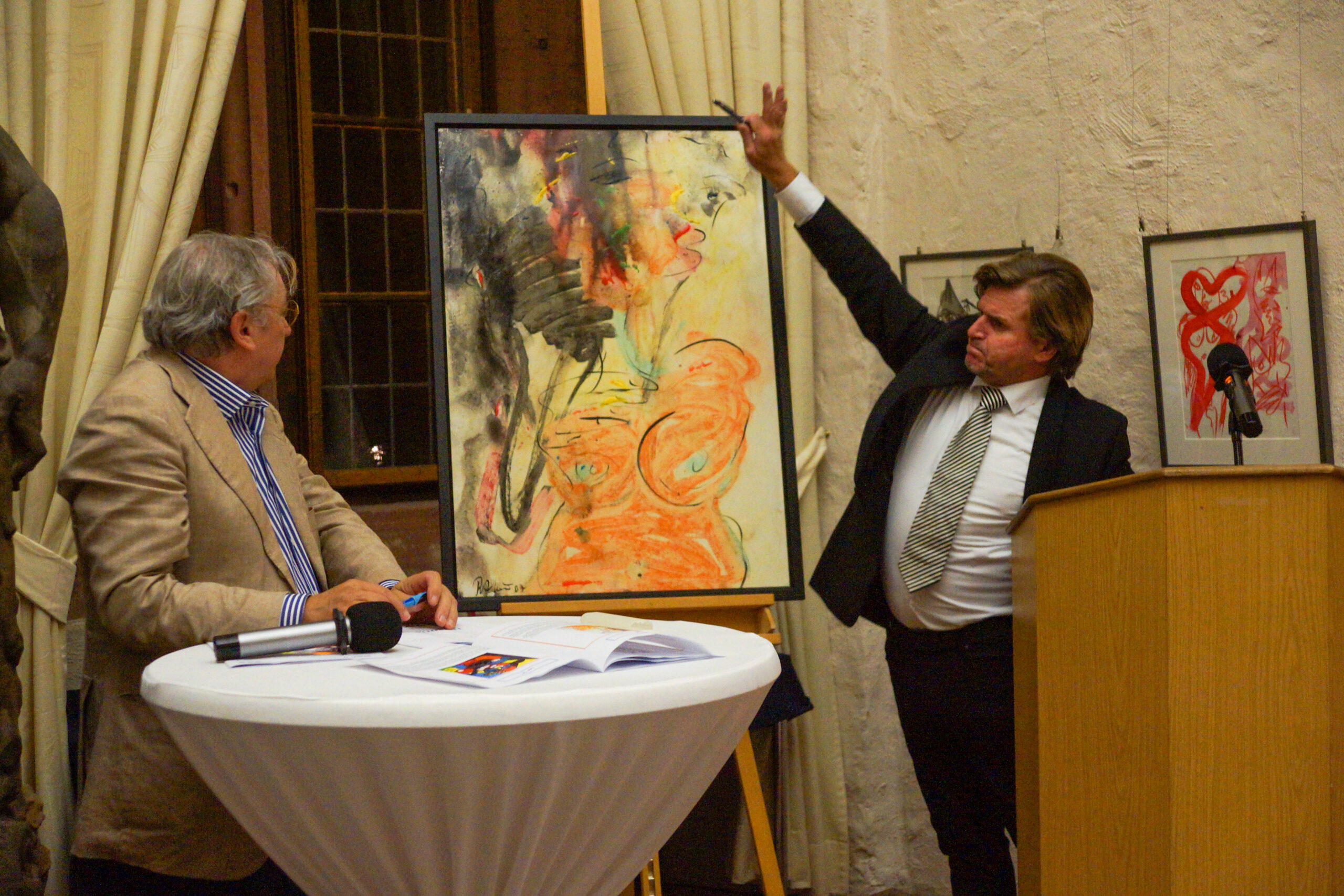
Rather than simply awarding the first hammer at 7:00 PM, the broadcast began with a tour through the exhibition. Dr. Kristina Hoge commented on the seven motif groups underlying the exhibition concept – works from various creative periods in direct comparison, instead of the usual chronology. Only afterwards did the camera move to the auction room.
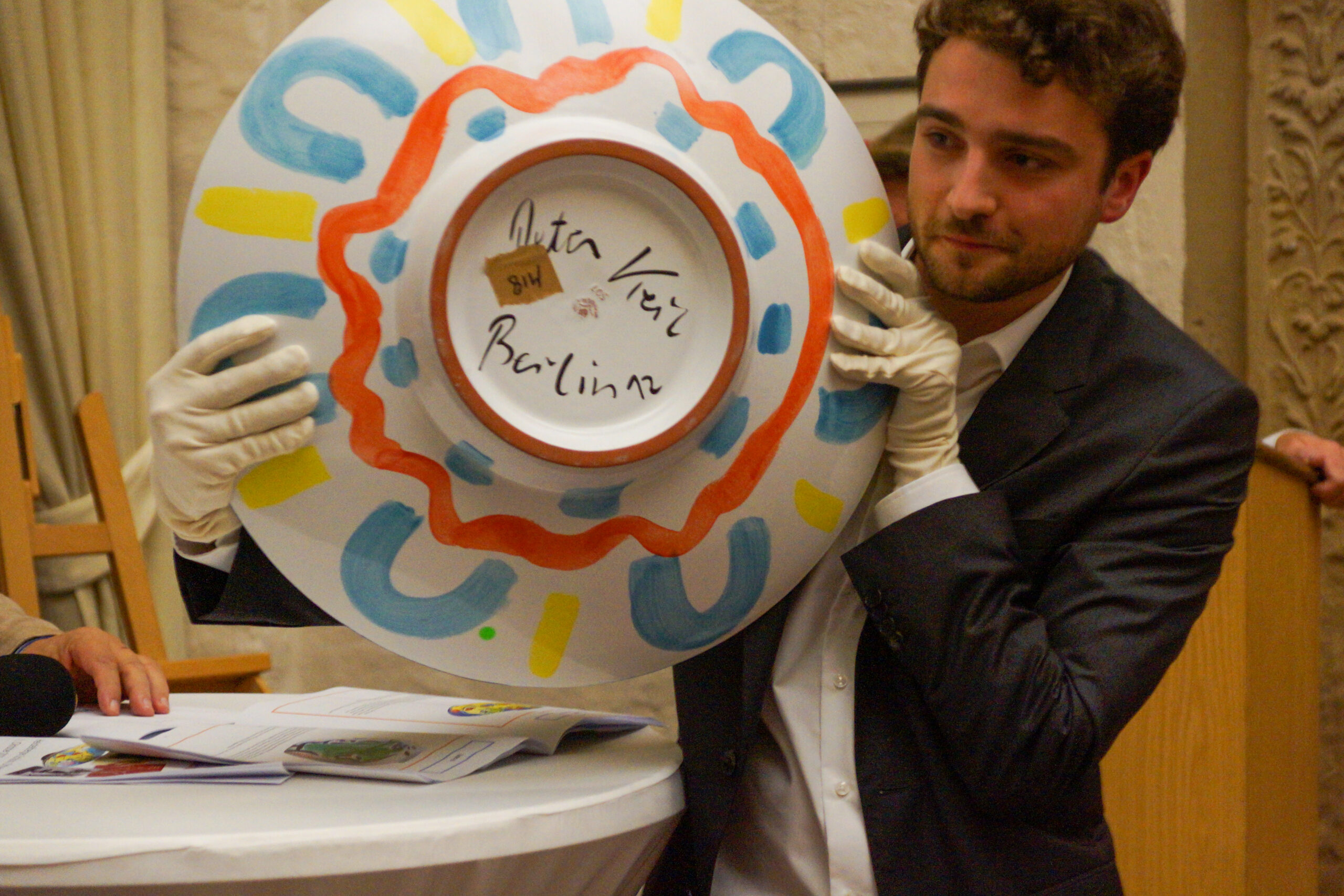
There, Michael Lehrberger from Auction House Historia took over – an auctioneer who can hold an audience even when five minutes of conversation lie between two lots. And that was precisely the point: between the hammer awards, the focus was consistently on communication. The long-standing Majolika employee Ms. Bayne, for example, explained the complete production process of a Majolika ceramic, including both firings. Those who watched understood in the end not only what a work costs, but why.
Why hybrid – and what that means technically
Hybrid does not mean placing a camera in the hall. It means serving two audiences simultaneously who have completely different needs: guests on site want atmosphere, proximity to the artist, conversation. Viewers in the stream want image, sound, detailed shots, and the assurance that their bid arrives. This must be planned in advance:
- Direction and dramaturgy – a sequence that functions as a broadcast while still not excluding a room full of guests.
- Parallel platforms – six streaming and bidding channels simultaneously, with clean bid reconciliation in real time.
- Lot presentation for the lens – each work presented so that signature, material, and condition remain legible even on a screen in California.
- Content instead of downtime – the waiting periods are the actual gain: this is where trust develops, and trust determines bids.
The result: all 16 works called were sold – with bids from Germany, Austria, Switzerland, Italy, France, and the United States. 50 percent of the proceeds went as a donation to the Xylon Museum in Schwetzingen.
The framework: vernissage, book, congratulations
The auction was the culmination of an evening that had begun at 4:00 PM. Over 100 guests had traveled from across the country and from abroad. The program included the introduction to the work by Dr. Kristina Hoge, readings by the poet Rainer René Mueller, musical sets by Jule Werner & Band – and the presentation of the book “Keil 80,” designed by poster artist Götz Gramlich, with QR codes that lead readers directly to the collection’s videos. The first 80 copies are numbered and signed.
Also presented was a booklet with over 30 congratulatory messages from admirers – including one from Bundestag President Bärbel Bas.
What the project demonstrated
In 2022, hybrid was still an emergency measure from the pandemic era for many institutions. This project proved the opposite for me: properly constructed, the hybrid format is not an inferior live auction, but a genre in its own right. It reaches bidders who would never have traveled, it makes expert knowledge part of the sale rather than a footnote in the catalogue – and it works even when the lots do not carry million-dollar estimates.
Precisely this combination of auction expertise, digitalization, and communication has remained the core of my work.
More on this: Digitalization · All Projects