Estate of Klaus Blochwitz – a complete body of work in fourteen years
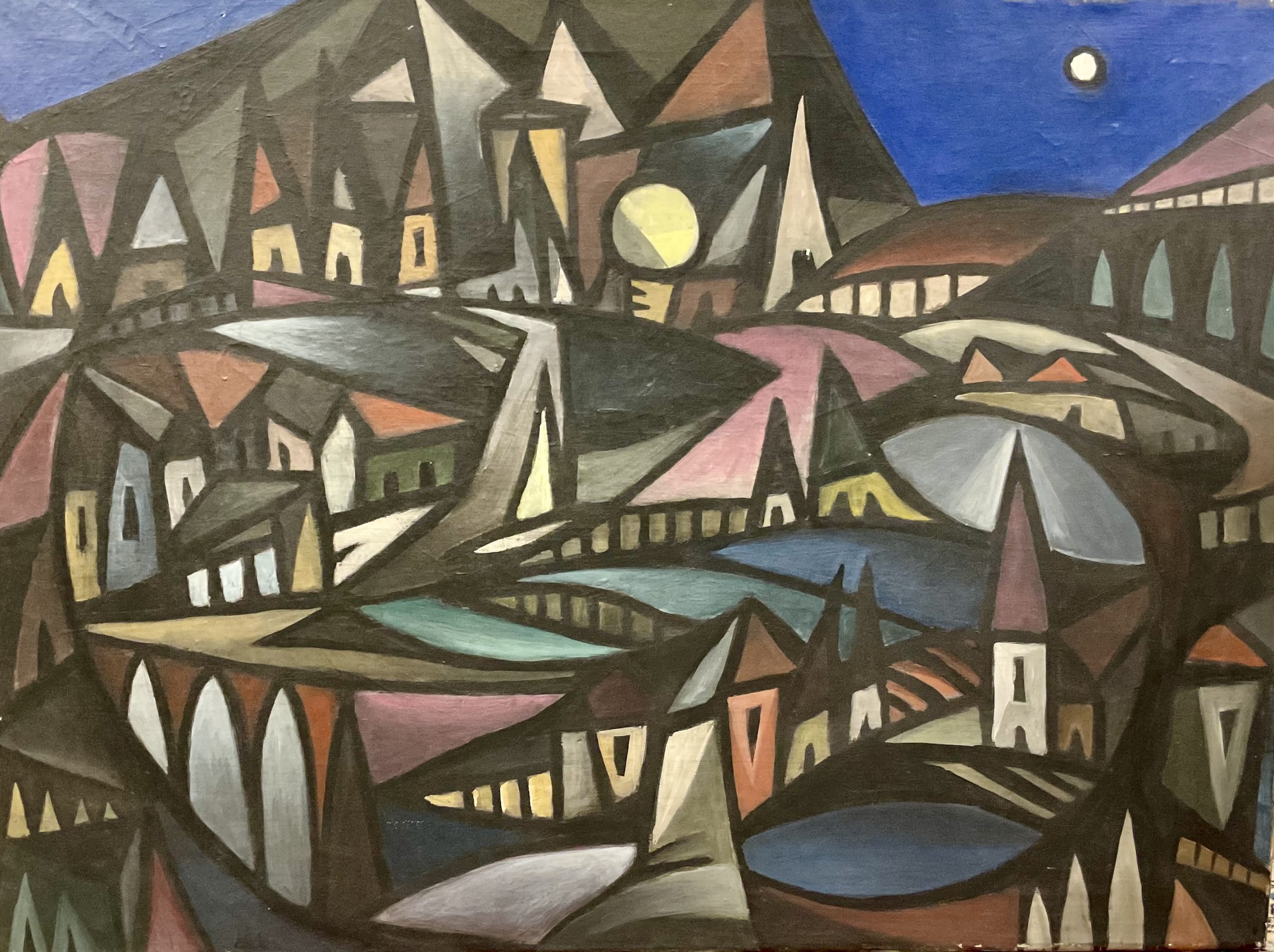
Most artist estates tell the story of a long life. The estate of Klaus Blochwitz (1934–1968) tells the opposite: fourteen working years in which an artist undergoes a development for which others need four decades. From sculptural design to color-intensive painting, from painting to collage, from collage to a visual language that addresses the Vietnam War. And then it breaks off.
Together with the Antik-Center Berlin, I have processed this estate: sighted, organized, structured into work phases, and made it accessible for the market. With such a short and heterogeneous oeuvre, this is precisely the actual work—because without order, a body of work with five stylistic phases does not appear versatile, but arbitrary.
An education at the center of post-war modernism
Blochwitz was born in Berlin on August 12, 1934, and studied from 1953 to 1955 at the Meisterschule für Kunsthandwerk under Hans Uhlmann, followed by studies from 1955 to 1961 at the Hochschule für bildende Künste Berlin—again under Uhlmann. On June 28, 1960, he was awarded the title of master student (Meisterschüler) under Karl Hartung.
Anyone familiar with these two names knows where Blochwitz stood. Hans Uhlmann (1900–1975) is considered the founder of metal sculpture in Germany; he had been imprisoned in 1933 for a leaflet campaign and established the first metal sculpture class in Germany at the HfbK in 1953. Karl Hartung (1908–1967) came from the craft of wood carving and found his way to abstraction via Brâncuși, Archipenko, and Arp. Both were represented at documenta 1, II, and III—exactly during the period when Blochwitz was studying under them. He did not grow up on the fringes of West German post-war modernism, but in its engine room.
Five phases in fourteen years
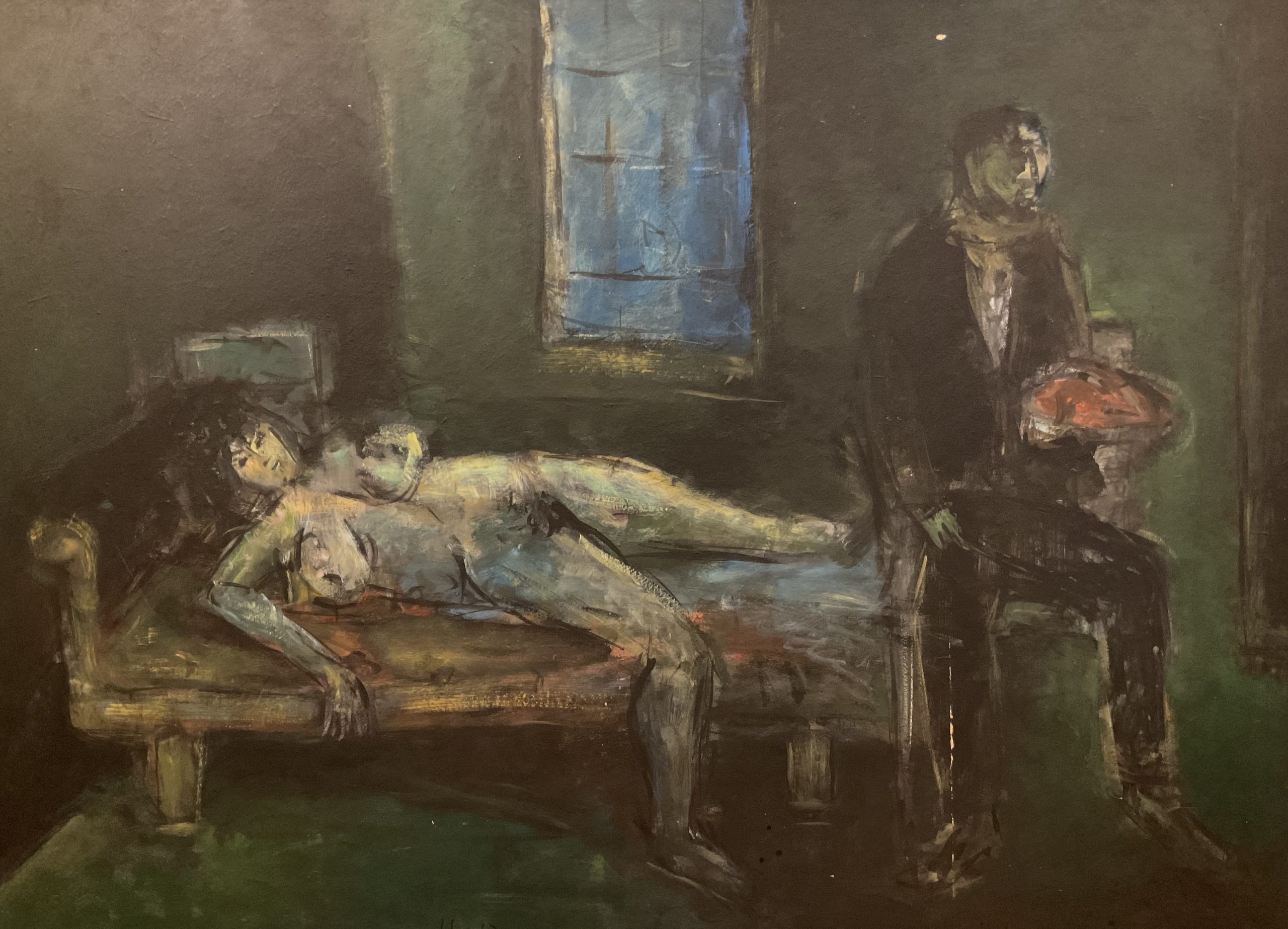
What makes the estate unusual is the speed of development. Blochwitz went through stylistic phases that hardly fade into one another but are clearly distinct:
Sculptural design and geometry
Sculptural designs and geometric form-color compositions — the signature of the Uhlmann school, conceived from the perspective of space.
The shift to painting
Color-intensive still lifes, compositions, maritime and exotic landscapes, portraits of women. The most productive and accessible phase of the work.
Collage, gender, cross
Blochwitz experiments with image collage. Gender themes come to the fore, the cross becomes a recurring motif.
Vietnam
The war impacts the work directly — titles such as “War in Vietnam”, “On the Run”, or “Battle at the Red River” speak for themselves.
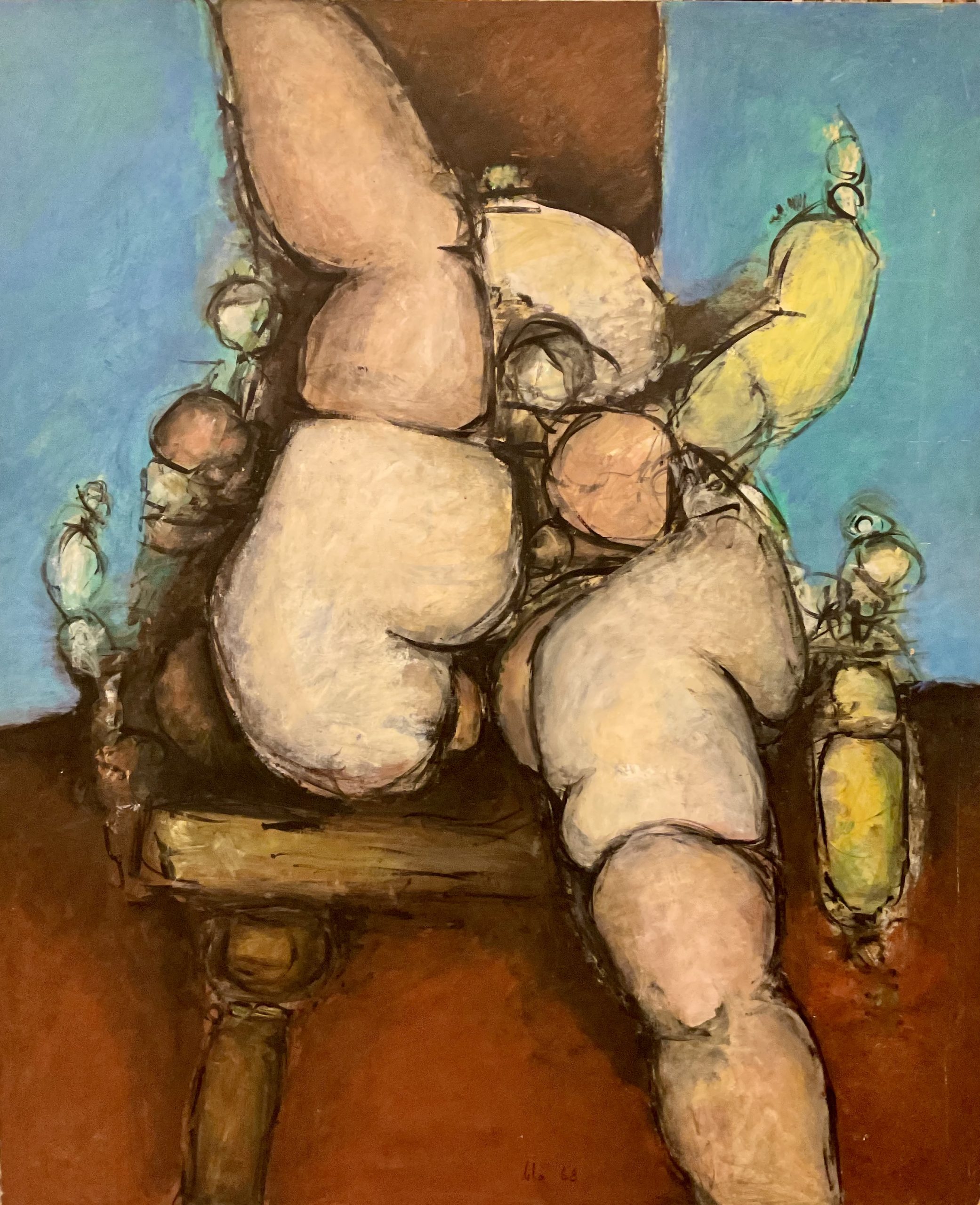
Anatomy dissolves into clouds
Body forms transition into cloud formations until the cloud itself becomes the center of the image. The final and formally most independent invention of the oeuvre.
Blochwitz died by suicide in 1968 at the age of 34. On the project partner’s website, a connection is suggested between the dissolved late work and his death. I consider this unverifiable and would advise against reading the work backwards from its end: the cloud paintings are a formal solution, not an announcement. What remains is an oeuvre that stopped in the middle of a movement.
What the collection contains
The estate includes works from the years 1954 to 1968 in various techniques. On canvas and hardboard, one finds, among others, “The Seated Woman”, “Two Spaceships”, “Painter and Model”, “Suburban Settlement”, “Clouds over the City”, “Evening at the Havel”, “Canale Grande”, and “In Front of the Cinema” — a list of titles that well reflects the thematic range: everyday life, nude, city, travel, war.
In addition, there is an extensive collection of works on paper: twenty-five numbered sheets under the title “Sculptures”, six variations of “Abstract Figuration”, four of “Abstraction”, two of “Abstract Composition”, as well as individual sheets such as “Hand Study” and “Geometry”. This paper collection in particular is the key to understanding the overall oeuvre — it shows the sculptor Blochwitz was first and makes it clear why his painting is so strongly conceived in terms of volume.
What we have done with the estate
Every work is signed, dated, numbered, marked with the estate stamp, and recorded in the catalogue raisonné. This completeness is the basic prerequisite for a collection to become negotiable for collectors, galleries, and museums at all — without a catalogue raisonné, a group of works is a stack of pictures; with a catalogue raisonné, it is an oeuvre.
The actual task with Blochwitz, however, lay one level above: surveying the entire collection, appraisal, classification within the art-historical context, and the development of a realization strategy that understands the work as a coherent whole and not as an assortment. With five clearly distinguishable stylistic phases, the temptation is great to pick out only the most marketable — the color-intensive landscapes and nudes of the early sixties undoubtedly sell more easily than the Vietnam works. That would be exactly the mistake. Holistic, without cherry-picking: for an artist whose body of work was already too short, this is not a question of style.
What This Project Demonstrates
A short body of work is not automatically a small one. Blochwitz leaves behind an oeuvre that contains more development than some forty-year careers — but it needs someone to make this development visible. This is precisely the difference between a stored estate and a processed one: one is a collection of unknown sheets, the other is a narrative with a beginning, turning points, and a break that can be named.
I offer this combination of estate processing, catalogue raisonné, and market understanding to families, communities of heirs, and institutions facing an artistic estate. Another example from the same collaboration is the Estate of Benedikt Brun-Stiller; further works can be found under Projects.
The processed collection can be viewed at the project partner: Klaus Blochwitz Collection at Antik-Center Berlin. A digital version of the catalogue raisonné is available upon request.
Are you managing an artist’s estate that deserves more than a storage facility?
In an initial consultation, we will clarify without obligation and confidentially what the collection contains and how it can be made visible.