The Benedikt Brun-Stiller Estate – An Expressionist Forgotten by the Market
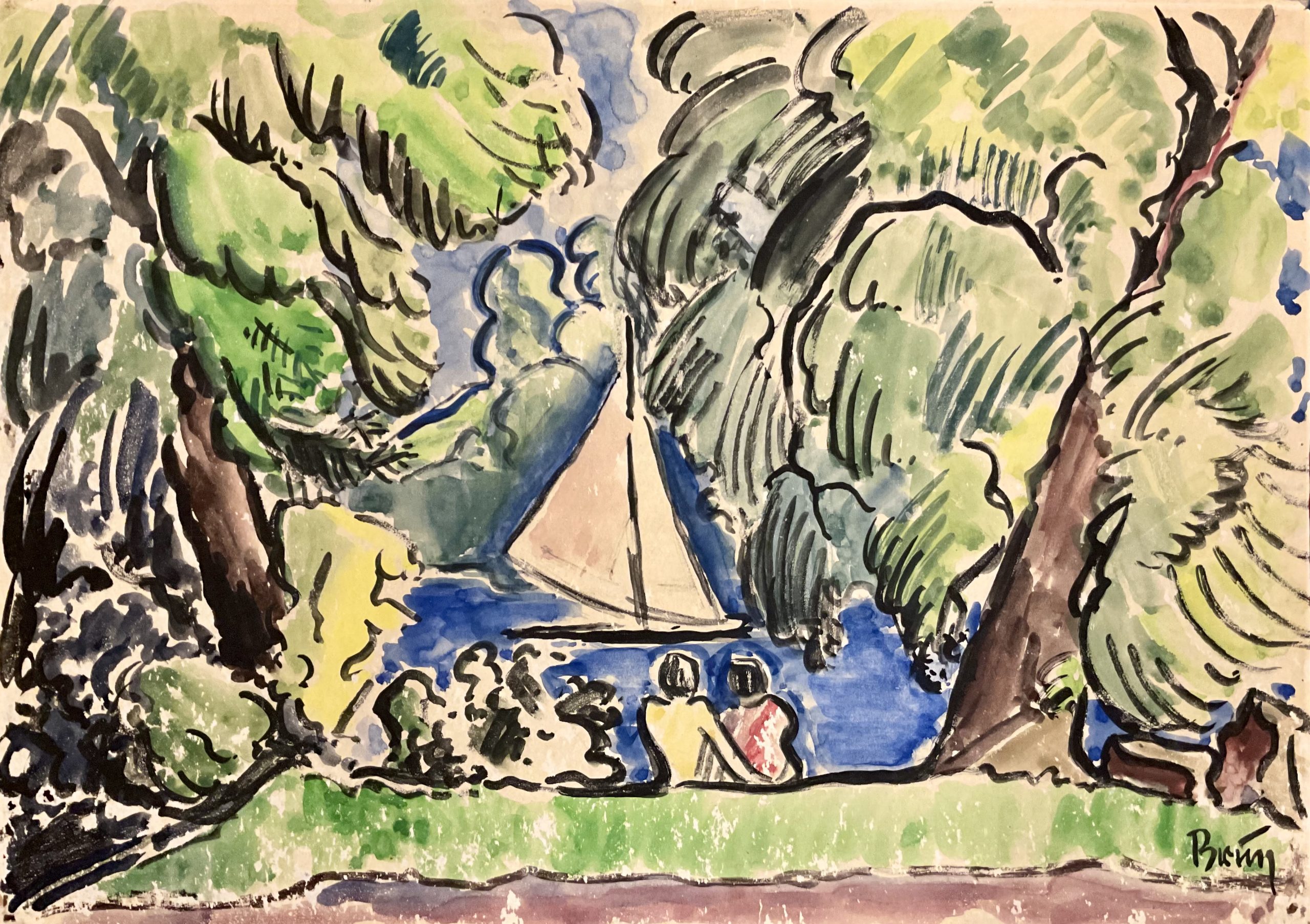
There are artist estates where the work consists of managing a well-known name. And then there are those where it consists of making a name legible again in the first place. Benedikt Brun-Stiller (1897–1986) belongs to the latter category – making him a prime example of what estate work must actually achieve.
Together with Antik-Center Berlin, I have re-processed the estate: sighted, organized, appraised, and made it market-ready. The result is a collection that can now be presented with a catalogue raisonné, estate stamp, and full documentation – and an artist whose biography explains why he remained under the radar for so long.
The Lost Generation
Brun-Stiller was born in Breslau in 1897 – and thus into a birth year for which art history has coined its own term. In 1980, the art historian Rainer Zimmermann grouped German artists born between 1890 and 1914 as the “Lost Generation”: a generation that was trained during the Weimar Republic and was just beginning to establish itself when the Nazi era shattered their careers. Exhibition bans, confiscated works, military service, bombed-out studios – and after 1945, an art market that only wanted to see abstraction.
Brun-Stiller’s work stands precisely in this gap. He remained loyal to Expressionism long after the market had turned away. This is the core of his artistic integrity – and at the same time the reason for his decades of invisibility.
An education one could not invent
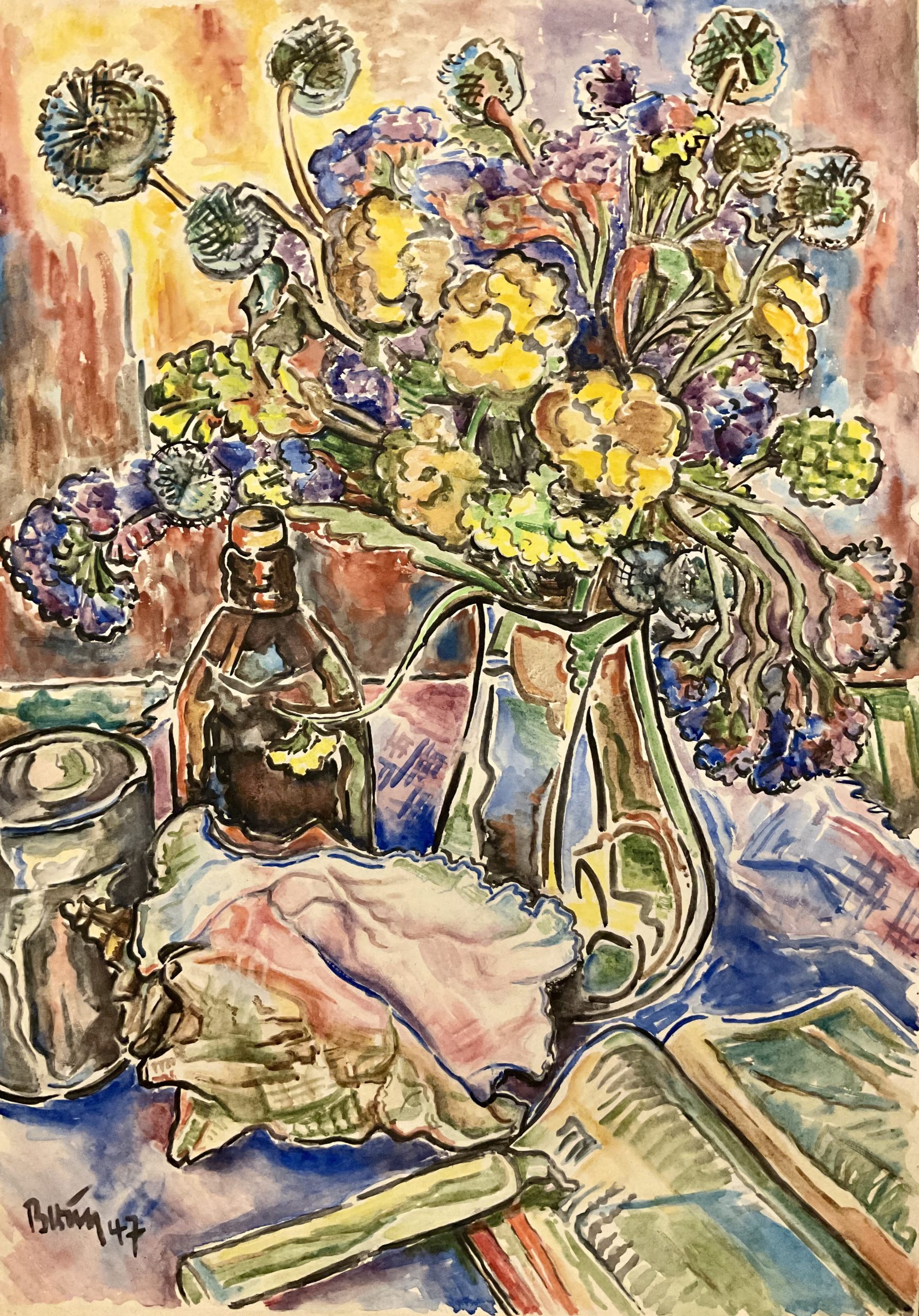
From autumn 1919, Brun-Stiller studied at the State Academy of Arts and Crafts in Breslau – under Oskar Moll, a student of Henri Matisse, and Otto Mueller, one of the founding members of the “Brücke” artist group. In parallel, he attended art history lectures by Wilhelm Pinder, August Grisebach, and Fritz Weege. It is a list of teachers that could hardly be more concentrated within German Expressionism.
However, an encounter in the 1920s in Jershöft, Pomerania, proved more formative than any academy: there, Brun-Stiller met Karl Schmidt-Rottluff, also a founder of the Brücke. This meeting turned into a lifelong friendship. Schmidt-Rottluff instructed him in color theory and remained his artistic benchmark – so much so that for years after the latter’s death, Brun-Stiller placed a wreath on his grave every All Souls’ Day.
War, captivity, a new beginning in Berlin
Drafted in 1939, in American captivity in 1945, followed by medical drawings for the Soviet side in Beelitz – Brun-Stiller’s path through the war and post-war years is that of an entire generation. In April 1947, he went to Berlin and started literally from scratch: in the first few months, he bartered vegetables for painting materials. Schmidt-Rottluff helped him settle in.
In 1950, Brun-Stiller participated in the opening exhibition of the Haus am Lützowplatz – the venue that two decades later, in 1973, hosted his solo exhibition “Brun-Stiller – Watercolors and Oil Pastels” featuring 44 works from the years 1931 to 1973. From 1964, he worked voluntarily at night for fifteen years at a Caritas homeless mission in Franklinstraße.
What he painted – and what is conspicuously absent
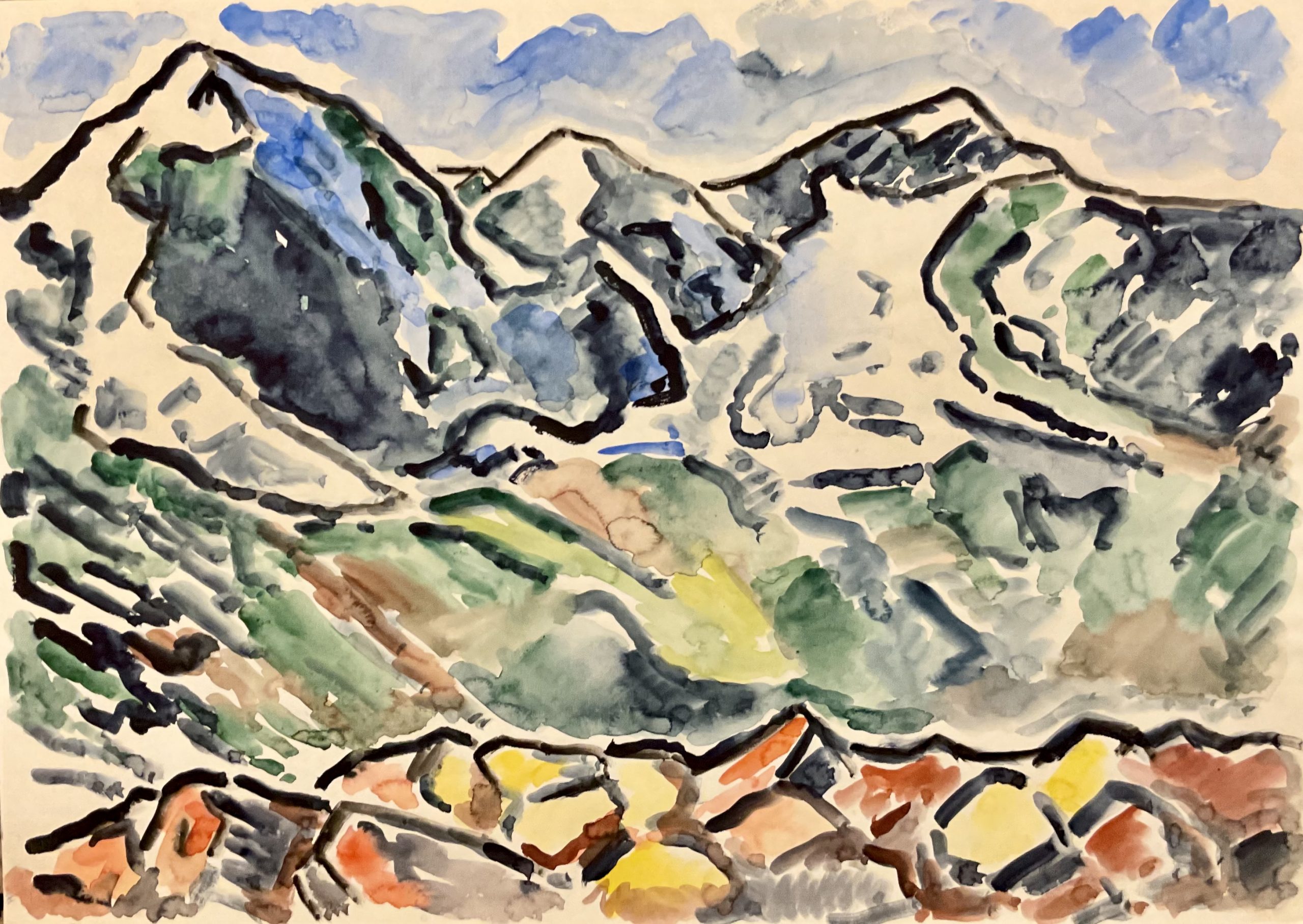
Fifteen years of night shifts with the homeless, and not a single work that speaks of it: in Brun-Stiller’s pictorial world, the human figure practically does not exist. He painted landscapes, cityscapes, and above all, flowers. Fresh flowers were so important to him that he twice bartered framed paintings for bouquets from his florist. Travels to South Tyrol, Southern Italy, France, and South Africa in the 1970s expanded his repertoire of motifs without changing the fundamental tone.
One can read this as an evasion. One can also read it as it feels when viewing: as a deliberately maintained counter-space to a life that had seen enough hardship.
What we did with the estate
The holdings comprise works from 1952 to 1975 in a range of techniques. Each work is signed, dated, numbered, bears the estate stamp, and is recorded in the catalogue raisonné. This completeness is not an end in itself: it is the prerequisite for an estate to become negotiable at all for collectors, galleries, and museums. Without a catalogue raisonné, a group of works is a stack of pictures; with a catalogue raisonné, it is an œuvre.
Our task in the project was the second layer above that: reviewing the entire collection, appraisal, placing the work in its art-historical context, and developing a realization strategy that does not just pick out the twenty best sheets. Holistic, without cherry-picking – for an artist who has been overlooked for too long anyway, this is not a question of style, but a question of integrity.
What This Project Demonstrates
An estate does not become valuable simply by being stored. It becomes so because someone does the work: documenting, categorizing, narrating, selling – in that order. In Brun-Stiller’s case, the art-historical classification was itself part of the value creation. Those who know the term “Lost Generation” see something different in these sheets than someone who only reads an unknown signature abbreviation.
It is precisely this combination of estate processing, catalogue raisonné, and market understanding that I offer to families, communities of heirs, and institutions facing an artistic estate. Further projects can be found under Projects.
The processed collection can be viewed at the project partner’s location: Benedikt Brun-Stiller Collection at Antik-Center Berlin. A digital version of the catalogue raisonné is available upon request.
Are you managing an artist’s estate that deserves more than a storage unit?
In an initial consultation, we will clarify without obligation and in confidence what lies within the collection and how it can be made visible.